
Why are industrial safety scissors safer than safety knives?
1. Physical Limitation of Exposed Blade
Edges: This is the most fundamental difference: Safety Knives: Despite
automatic retraction or concealed blade designs, the blade remains an exposed
"point" or "line." During use, if the cutting angle
deviates or improper force is applied, the blade can still cut the user. Safety
Scissors: The blades are usually blunted. The cutting principle of scissors is
not based on the sharpness of the blade "cutting," but on the
shearing force generated when the two blades meet. In non-shearing actions,
fingers touching the blade usually will not be cut.
2. Controlled Cutting Path: Safety Knives:
The cutting path of safety knives is usually "open." If slippage
occurs while cutting material, the blade will swing outwards due to inertia,
easily causing accidental injuries. Safety Scissors: The range of motion of
scissors is limited to "opening and closing."
3. Contact Area and Pressure: According to physics, the contact
area of a safety knife's tip or blade is extremely small. Therefore, even a
small force can generate immense pressure, easily piercing the skin. Safety
scissors typically have rounded tips and thicker blades, significantly
increasing the contact area and preventing accidental punctures or punctures in
pockets.
4. Operating Mechanics and Stability: Knives
usually require single-handed pulling, with the force typically directed
towards the body or side. Scissors, on the other hand, use two fingers for a
more stable grip, concentrating force on the opening and closing motion rather
than pulling. This reduces the likelihood of the tool flying out due to
excessive force.
While scissors offer a higher safety margin,
in industrial applications, the two are often complementary. For example,
blades are more efficient when handling heavy cardboard boxes; however, safety
scissors are the preferred protective equipment when handling thin sheets,
fibers, or when precise operation is required and the environmental risk is
high. In addition to safety knives, HEWER also offers a
variety of industrial safety scissors, especially its unique non-slip safety
blade, which solves the long-standing problem of not being able to cut slippery
materials.
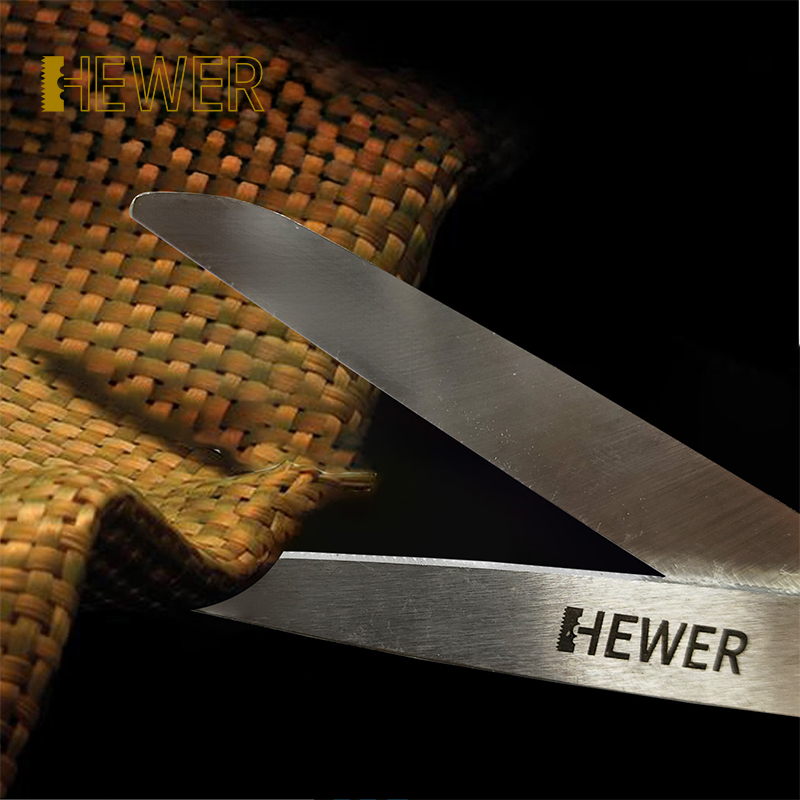
HEWER
MultiCUT food-grade safety scissors give you complete control over your work.
Neither blade is angled; all cuts are made at the correct angle. Therefore, you
won't cut yourself, only various materials. The blades provide an ideal support
surface, reducing the number of cuts needed to cut materials such as cardboard,
paper, film, and fibers. The metal parts of the scissors are made of stainless
steel, ensuring a long service life. The handle is coated with
fiberglass-reinforced plastic, further guaranteeing a long lifespan. The two
blades of the German HEWER MultiCUT safety scissors are fixed together by
screws, ensuring a robust cutting capability.
Features
of MultiCUT food-grade safety scissors: Blades suitable for cutting larger
foods and various fabrics, leather, paper, clothing, and soft materials.
Product
is EU FEC food-grade certified, hygienic and reliable.
Rounded
tip and flat blade design prevents accidents during cutting.
The
handle has a non-slip design for various cutting tasks, saving effort.
Environmentally friendly materials, stylish and non-slip, providing complete
comfort.
Suitable
for both right-handed and left-handed use.
Made
in Germany.
Visit
our website www.hewersafety.com or contact me for more information.